


If you've ever been gate-checked, forced to pay for an overhead-bin eviction, or panicked at TSA because your toiletry kit might be over the limit — you’re not alone. Airlines tighten the rules, gate agents enforce them, and every inch (and ounce) counts. This guide breaks down the real carry-on rules you need to know, the legal packing “hacks” that work in the real world, and the specific bag features to prioritize when you buy a carry on backpack / travel backpack — especially if you’re a guy who travels for work, weekends, or weekend-to-weeklong trips.

I pulled the latest official rules (TSA, FAA and major carriers) and recent enforcement patterns, then turned those into a practical, step-by-step playbook so you can travel lighter, smarter, and cheaper.
Quick reality check: the hard rules (what you must obey)
-
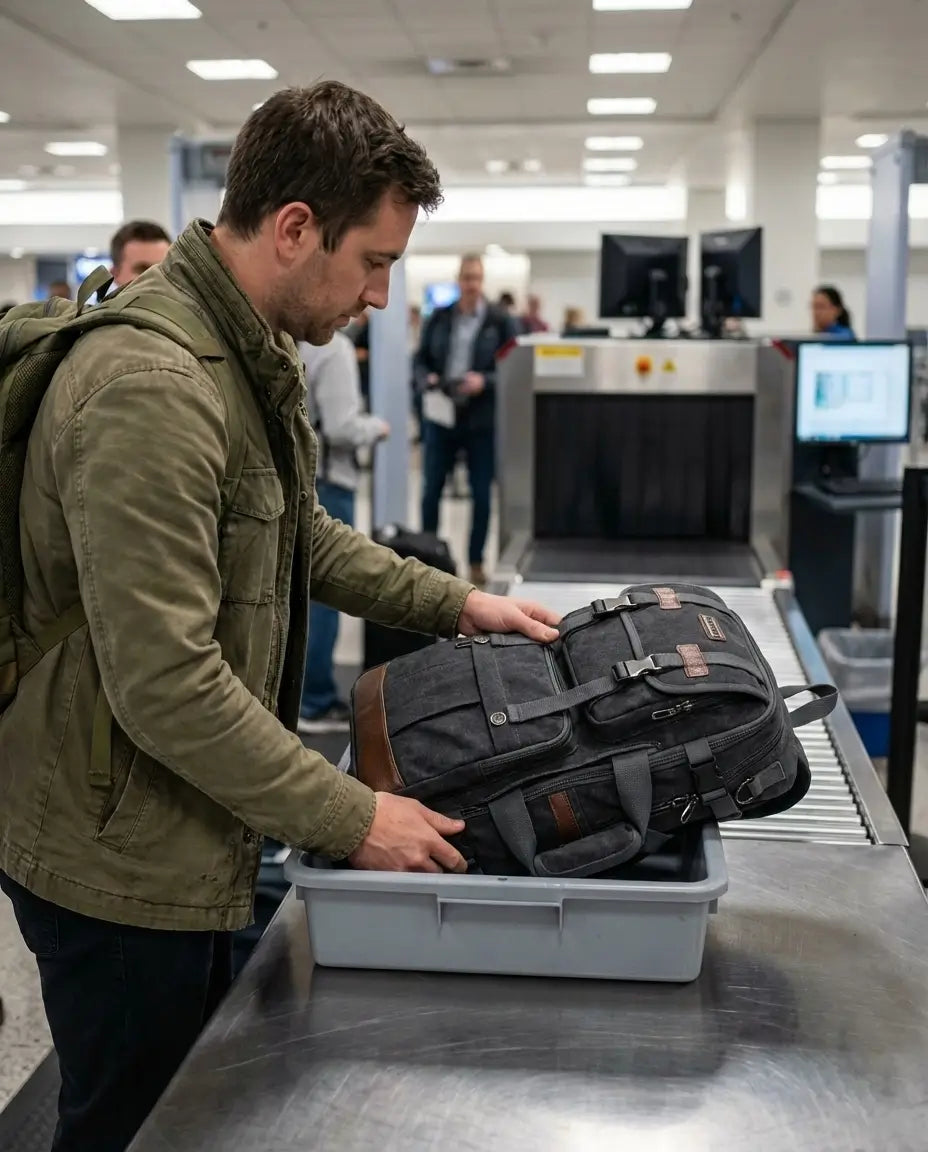
Liquids rule (3-1-1): All liquids, gels and aerosols in carry-ons must be in containers 3.4 oz / 100 ml or smaller and fit in one clear quart bag per passenger. This is non-negotiable at U.S. checkpoints. Lithium batteries & power banks: Spare lithium batteries and power banks must be carried in the cabin (carry-on), not checked luggage — airlines and the FAA treat these as potential fire hazards. Protect terminals from short circuits.
-
Size counts — and airlines measure differently: In the U.S. the de-facto standard most carriers use is about 22 × 14 × 9 in (including handles/wheels) for an overhead carry-on; specifics and enforcement can vary by carrier and aircraft type. Measure carefully.
These are the rules you’ll get in trouble for. Everything else is enforcement preference or cabin space politics — which brings us to the “clever” part.
Airlines don’t like you knowing this — but it’s perfectly legal
-
Soft-sided backpacks compress. A soft, fabric carry on backpack can be squished into an overhead bay when hardshells won’t fit. That’s not cheating — it’s using the material the way it was designed. (Remember: measurements include handles, pockets, compressions straps and exposed zips, so don’t ignore them.) United Airlines
-
Personal-item poker: Many carriers permit one carry-on + one personal item. A roomy men’s travel backpack that qualifies as a personal item and a compact carry-on in your second item maximizes legal space. (Policies vary — always verify for your carrier.)
-
Wear your bulkiest gear. Jackets, boots, or a heavy sweater worn on the plane reduce measured volume and weight in your bags — fully legal and zero fees.
-
Distribute tech cleverly. Put power banks and spare batteries in your on-body pockets or an easily accessible front compartment — compliant with FAA/TSA rules and safer for screening.
-
Know the airline’s enforcement posture. Low-cost carriers (and some European airlines) have aggressive gate-checking and sizing checks; others are more flexible if bins have space. Ryanair and a few budget operators are tightening checks and fining oversized carry items — so “soft-squeeze” tactics work better on U.S. legacy carriers than on gate-strict low-cost lines.
How to pick the best carry-on (features that practically save you money)
When you’re shopping for a carry on travel backpack or a carry on luggage backpack, focus on features that help you fit, organize, and move — not on gimmicks.

Priority features (short list):
• Soft-sided exterior / compression panels — lets you squeeze into tight bins.
• Low-profile wheels & tuckaway handles (if it’s a hybrid backpack/rolling bag) — minimizes measured size.
• Structured laptop compartment with quick-access panel — keeps electronics accessible and protected.
• External quick pocket for documents and quart bag — speeds up security lines.
• TSA-friendly toiletry sleeve or removable clear pouch — keeps you within the 3-1-1 rule and makes screening smoother.
• Protected power-bank pocket (easy access, padded, and terminal-covered) — keeps you FAA/TSA compliant. TSA
• Balanced suspension / padded hip belt — distributes weight so a fully packed 40L travel backpack for men doesn’t destroy your back.
• External shoe/dirty pocket or separate bottom compartment — useful for weekend travel backpacks and keeping smells away.
• Lightweight, water-resistant nylon fabric — durable, easy to compress (think black nylon backpack).
Those features make a bag behave in the real world of airports — getting you on the plane and keeping you comfortable.
Packing techniques every man should master (the practical one-bag mindset)
-
Fold + roll hybrid: Fold dress shirts, roll casuals. Roll compression cubes for T-shirts, underwear, socks — keeps shape and saves volume.
-
Use packing cubes by function: tech cube, underwear cube, clothes cube. Pull the tech cube on security instead of digging through the main compartment.
-
Fill dead spaces: shoes take space — pack socks inside them. Small gadgets go in eyeglass case or shoe bag.
-
Wear the weight: heavier shoes and jacket worn on the plane keep bag dimensions down and reduce weight in the measured bag.
-
Quarter-turn trick for bulky collars: turn bulky collars inside out and fold flat — saves a surprising amount of height.
-
Designate a “security” pocket: keep your quart bag and documents in a single front pocket to speed through checkpoints.
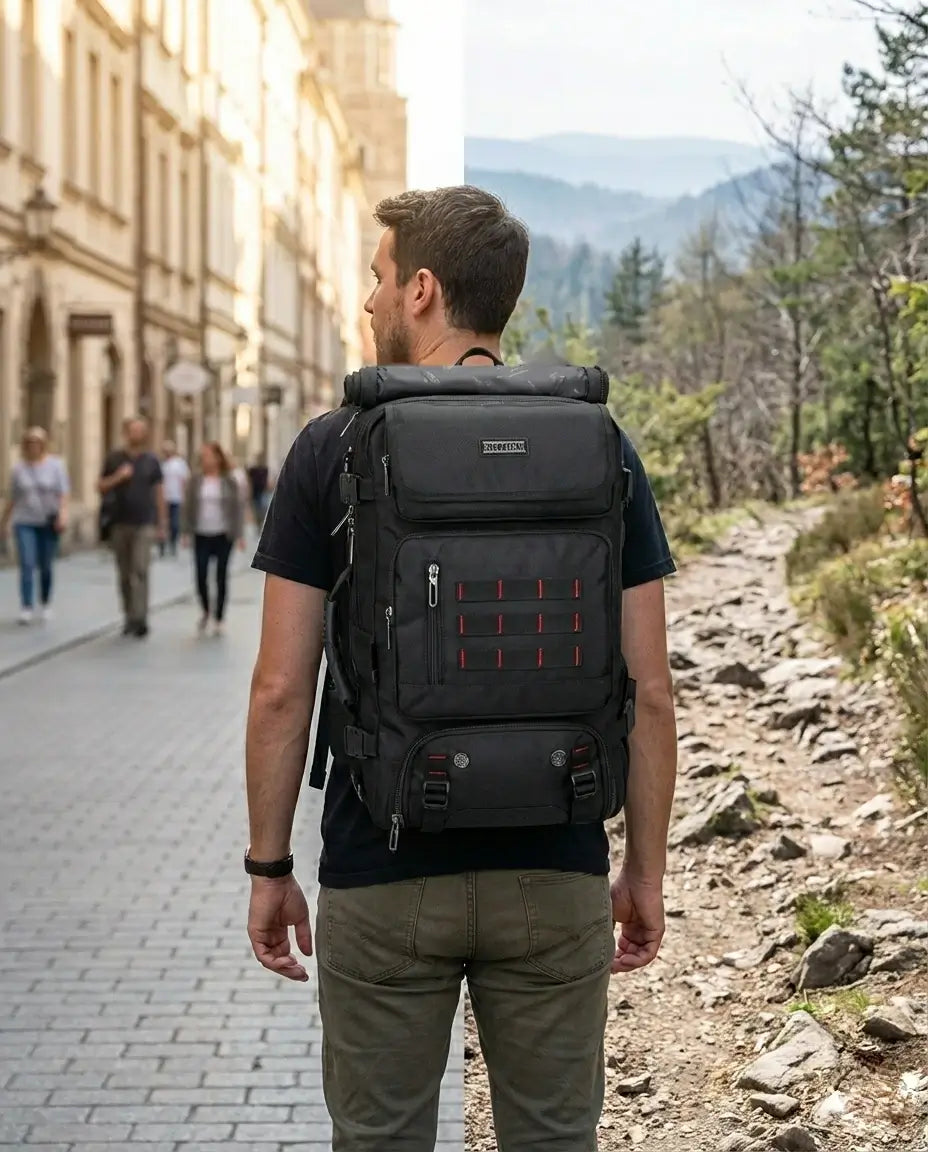
These simple moves let a 40L travel backpack or a men’s large travel backpack serve as a legitimate carry on backpack for multi-day trips without oversize fees.
The legal “bin-friendly” bag blueprint — what to look for in spec form
(Handy when comparing product pages.)
• External dimensions (packed): aim ≤ 22 × 14 × 9 in for U.S. flights — or check the specific airline if flying Europe/low-cost.
• Capacity: 30–45 L is the sweet spot for 1–7 day trips (weekend travel backpack → 30–40L; weekender / men large travel backpack → 40–45L).
• Weight (empty): under 3.5 lb / 1.6 kg preferred for backpacks — lighter means more usable payload.
• Material: 600D–840D nylon or technical ballistic nylon resists abrasion and compresses better than thick canvas (great for a travel nylon backpack).
• Laptop sleeve: padded, side-loading or front-panel access for fast TSA checks (fits up to 15.6" is common).
• Security: lock-compatible zips + anti-theft rear pocket.
• Organization: dedicated shoe pocket, power bank pocket, breathable back panel, luggage-strap.
If you’re shopping Witzman or any other brand, use these specs to compare models and pick the one that behaves like a carry-on — not just “looks” like one.
Real examples (how features translate into wins)
-
Removable clear quart pouch: keep it near the top. Pull it for security without fishing through everything. Speeds up screening and reduces scrutiny.
-
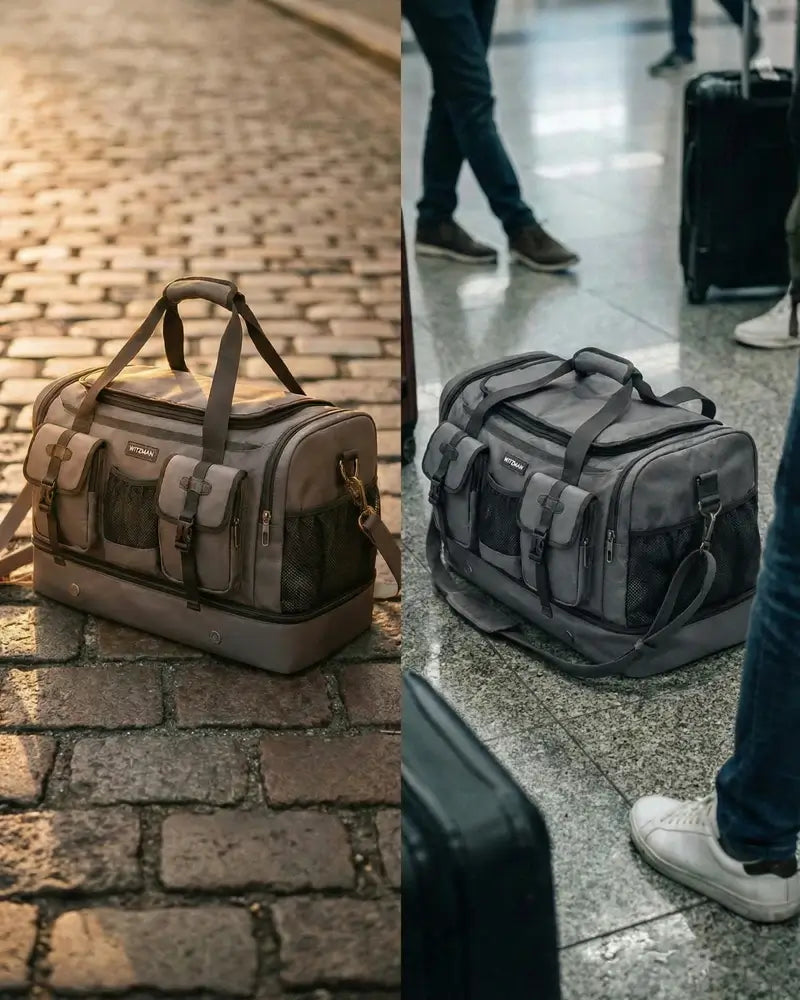
Low-profile wheels + tuckable handle on a hybrid backpack/duffel: reduces measured height and gives you rolling comfort in terminals.
-
External cable/charger pocket with terminal cover: keeps power banks accessible for inspection and avoids checked-baggage violations.
(If you want model suggestions tailored to 1-day, weekend, or 5-day trips, tell me your usual load — tech heavy, clothes heavy, or combo — and I’ll match specs.)
What airlines really check — and when they’ll charge you
-
At the gate: Overfull bags that won’t fit in the bin get gate-checked or fined — especially on full flights. Low-cost carriers have become strict about gate measures. Know your carrier’s posture before you fly. At security: TSA cares about prohibited items and liquids; size & weight checks are usually at the gate, not the screening line (unless something raises suspicion).
-
On boarding: If overhead space is scarce, even legal bags can be asked to gate-check. A soft-sided travel duffel backpack or a slim carry-on backpack frequently fares better.
Quick checklist before you leave home
-
Measure your bag including handles, wheels, external pockets — tape measure is your best friend.
-
Put all spare batteries & power banks in your carry-on pockets and protect terminals.
-
Quart-size clear bag with toiletries in an easy-access front pocket.
-
Wear your bulkiest jacket/shoes onto the plane.
-
Confirm your airline’s carry-on policy that morning (policies change and enforcement can vary by plane).
FAQ (short)
Q — Can I use a 40L backpack as a carry-on?
A — Yes — many 40L designs fit the 22×14×9 guideline if they’re soft-sided and well-packed. But check the airline for size rules and plane type.
Q — Are power banks allowed in checked luggage?
A — No — spare lithium batteries and power banks must be in carry-on.
Q — Will airlines measure my bag?
A — They may at gate/boarding. Low-cost carriers are more likely to enforce strict sizers; legacy U.S. carriers sometimes let soft-sided bags slide if bins have room.
Final word (and a practical nudge)
Packing smarter and choosing the right carry on backpack or travel backpack for men isn't about tricking airlines — it's about reading the rules, using materials and design to your advantage, and making every inch count. Pick a bag with compression, smart pockets for batteries and toiletries, and a layout that makes security a breeze. That way you avoid fees, gate-checks, and the awkward juggling act at boarding.
World travel directory
Travel directory including quality travel links all over the world.
http://www.wd-traveldirectory.com
Share:
The Art of Traveling Light: Premium Bags That Do More With Less
A Mischievous Guide to Wandering America